
Modern organisations are scaling across borders, channels, and regulatory environments. Whether operating under POPIA in South Africa, GDPR in Europe, or the CPRA in the United States, one truth is universal: trust is the currency of digital engagement. A Consent Management Framework (CMF) is the foundation of that trust: a system that ensures consent is captured legally, stored immutably, managed transparently, revoked instantly, and enforced consistently across an organisation’s entire ecosystem.
A CMF is an enterprise governance and technical system that ensures consent is lawfully obtained, immutably recorded, synchronised across all systems, and auditable across jurisdictions. It integrates legal standards, architecture, UX, APIs, and data ethics into one trust-enabling capability.
This page outlines the strategic purpose, regulatory drivers, technical architecture, UX requirements, auditability standards, and global compliance obligations that define an enterprise-grade CMF.
CMF vs CMP: The distinction that determines everything
Many organisations conflate Consent Management Frameworks (CMFs) with Consent Management Platforms (CMPs). They are not interchangeable.
Consent Management Framework (CMF)
A CMF is the enterprise governance, architectural and legal system that defines:
- how consent is obtained
- what wording must be used
- how consent is logged
- where it is stored
- how it is audited
- how revocation works across channels
- how regulatory differences are applied dynamically
- how vendors must be managed
Consent Management Platform (CMP)
A CMP is the operational interface—the banners, screens, SDKs, toggles and pop-ups that capture consent.
CMP = tool.
CMF = the entire system governing the tool.
The framework determines legality, auditability, interoperability, and defensibility. The platform merely executes what the framework prescribes.
Why consent management matters
Legal and regulatory obligations
Consent must be:
- freely given
- informed
- specific
- granular
- unambiguous
- documented
- revocable
- auditable
The most stringent regimes include:
- GDPR (EU) — explicit opt-in, granular, documented, revocable
- POPIA (South Africa) — specific, informed, voluntarily expressed
- LGPD (Brazil) — free, informed, unambiguous
- CCPA/CPRA (California) — opt-out regime with strong rights to reject sale/share
A CMF must handle all these models simultaneously.
Data ethics & user trust
A CMF is also a data-ethics control system. Research shows transparent, accessible privacy UX reduces opt-outs and increases loyalty.
Commercial advantage
Organisations with strong consent governance experience:
- fewer complaints
- higher engagement
- higher-quality data
- more accurate segmentation
- reduced regulatory risk
- stronger brand equity
Consent is no longer a checkbox; it is competitive infrastructure.
The global regulatory landscape
A CMF must dynamically interpret jurisdictional obligations:
| Jurisdiction | Default Model | Key Consent Requirements |
|---|---|---|
| GDPR (EU) | Explicit opt-in | Granularity, no pre-ticked boxes, burden of proof, easy withdrawal |
| CCPA/CPRA (US) | Opt-out | Implied consent; rights to opt-out of sale/share; opt-in for minors |
| LGPD (Brazil) | Explicit opt-in | Unambiguous, specific, renewal when purposes change |
| POPIA (SA) | Explicit opt-in | Specific, informed, voluntary; legacy research data challenges |
A CMP must use geolocation or similar methods to serve the correct banner based on jurisdiction.
The technical architecture of a CMF
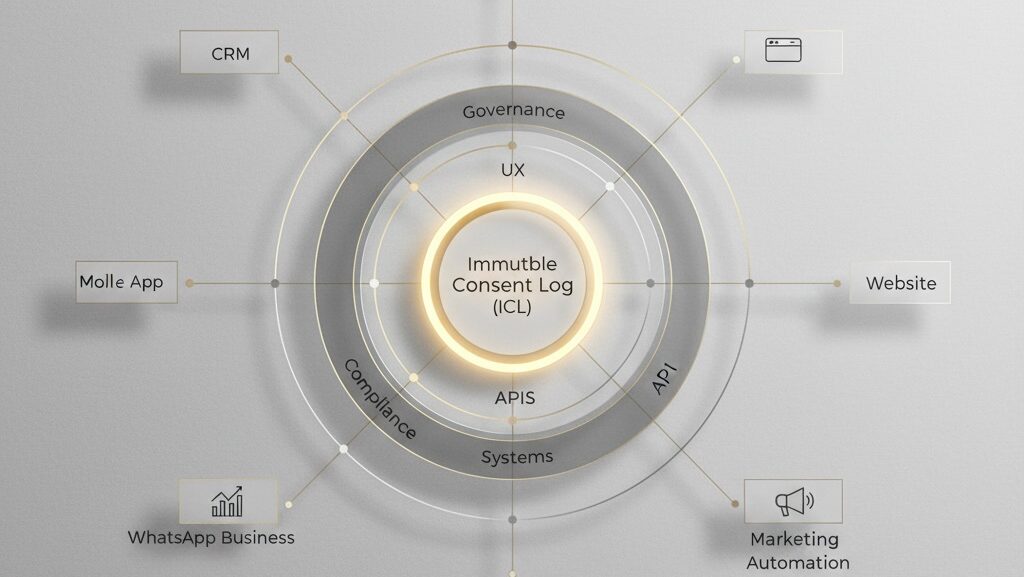
The Immutable Consent Log (ICL)
The ICL is the central, tamper-proof ledger that creates regulatory defensibility.
It captures:
- every consent event
- timestamps
- consent wording/version
- device, channel, identity linkage
- method of capture
- revocation events
- jurisdiction applied
This log cannot be overwritten. It must operate like a financial ledger.
Core technical layers
Consent Capture Layer (CMP/SDKs)
- Web, mobile, in-app, chat, WhatsApp
- Jurisdiction-aware rendering
- Accessibility compliant
Processing Logic Engine
Applies legal rules:
- opt-in vs opt-out
- granular purposes
- enforcement logic (tag firing, suppression)
Immutable consent log
- Append-only
- Time-sequenced
- Version control
- Audit-ready
Real-time synchronisation APIs
Sync consent states with:
- CRM
- CDP
- Analytics
- Marketing automation
- WhatsApp Business
- Email/SMS platforms
Revocation subsystem
- Dedicated API endpoint
- Atomic state changes
- Distributed enforcement in real time
Unified consent profile
Merges consent across devices and sessions into a single record.
UX and accessibility requirements
Consent UX is a legal requirement, not a design preference.
A compliant interface must:
- use plain, specific language
- avoid vague disclosures
- avoid dark patterns
- separate every purpose (granularity)
- include meaningful “Accept” and “Reject” options
- support layered transparency
- be WCAG 2.2 AA accessible
- avoid forced consent “cookie walls”
The Belgian DPA’s decision on the IAB TCF confirmed that vague wording invalidates consent.
Data Subject Access Rights (DSARs)
A CMF operationalises:
- right of access (full consent history)
- right to object
- right to withdraw consent
- right to portability
- right to delete
The ICL enables immediate retrieval of historic records to fulfil these rights.
Vendor risk and the IAB TCF lessons
The TCF rulings show:
- TC Strings are personal data
- IAB Europe is a joint controller
- Industry frameworks are not automatically compliant
A CMF must enforce:
- strict vendor assessment
- verification of vendor purposes
- alignment with granular user choices
- defensible documentation
Implementing a consent management framework
Phase 1 — Discovery
Channels, systems, vendors, scripts, data flows.
Phase 2 — Legal & UX Rebuild
Microcopy, lawful basis, UI patterns.
Phase 3 — Technical Enablement
ICL, APIs, synchronisation, data model.
Phase 4 — Governance & Monitoring
Audits, dashboards, incident handling, training.
The strategic value of a CMF
A mature CMF delivers:
- Legal compliance
- Operational efficiency
- Higher-quality data
- Stronger customer trust
- Global scalability
- Regulator defensibility
A CMF is nothing less than digital trust infrastructure.
How ITLawCo can help
| Capability | What ITLawCo provides |
|---|---|
| Regulatory Interpretation & Lawful Basis Architecture | Mapping of all processing activities to appropriate lawful bases; creation of purpose-specific consent requirements aligned to POPIA, GDPR, PDPL, LGPD, CPRA and other global regimes. |
| Consent Microcopy, UX Standards & Accessibility | Plain-language consent wording; interface patterns that avoid dark patterns; WCAG 2.2 AA–aligned UX; channel-specific microcopy for web, app, WhatsApp and CRM workflows. |
| Technical Blueprinting & Immutable Consent Log (ICL) | Design of data models, versioning layers, API requirements, ledger-style immutability and synchronisation flows for defensible, audit-ready consent history. |
| Omnichannel Integration & System Enablement | Integration support for CRM, websites, mobile apps, WhatsApp Business, CDPs, analytics pipelines and marketing automation platforms, ensuring real-time propagation of consent signals. |
| Governance, Playbooks & Assurance | Enterprise policies, standards, RACI models, escalation paths, audit controls, training scripts and operational playbooks to embed consent governance across functions. |
| Vendor Assessment & Third-Party Oversight | Evaluation of CMPs, AdTech providers, cloud vendors and processors; alignment to granular consent scopes; joint controllership and DPA compliance support. |
| Executive Briefings & Organisational Alignment | Strategic, board-level insights explaining risks, obligations, resourcing needs and architectural priorities to enable informed decision-making across ExCo and senior leadership. |
