The extended enterprise
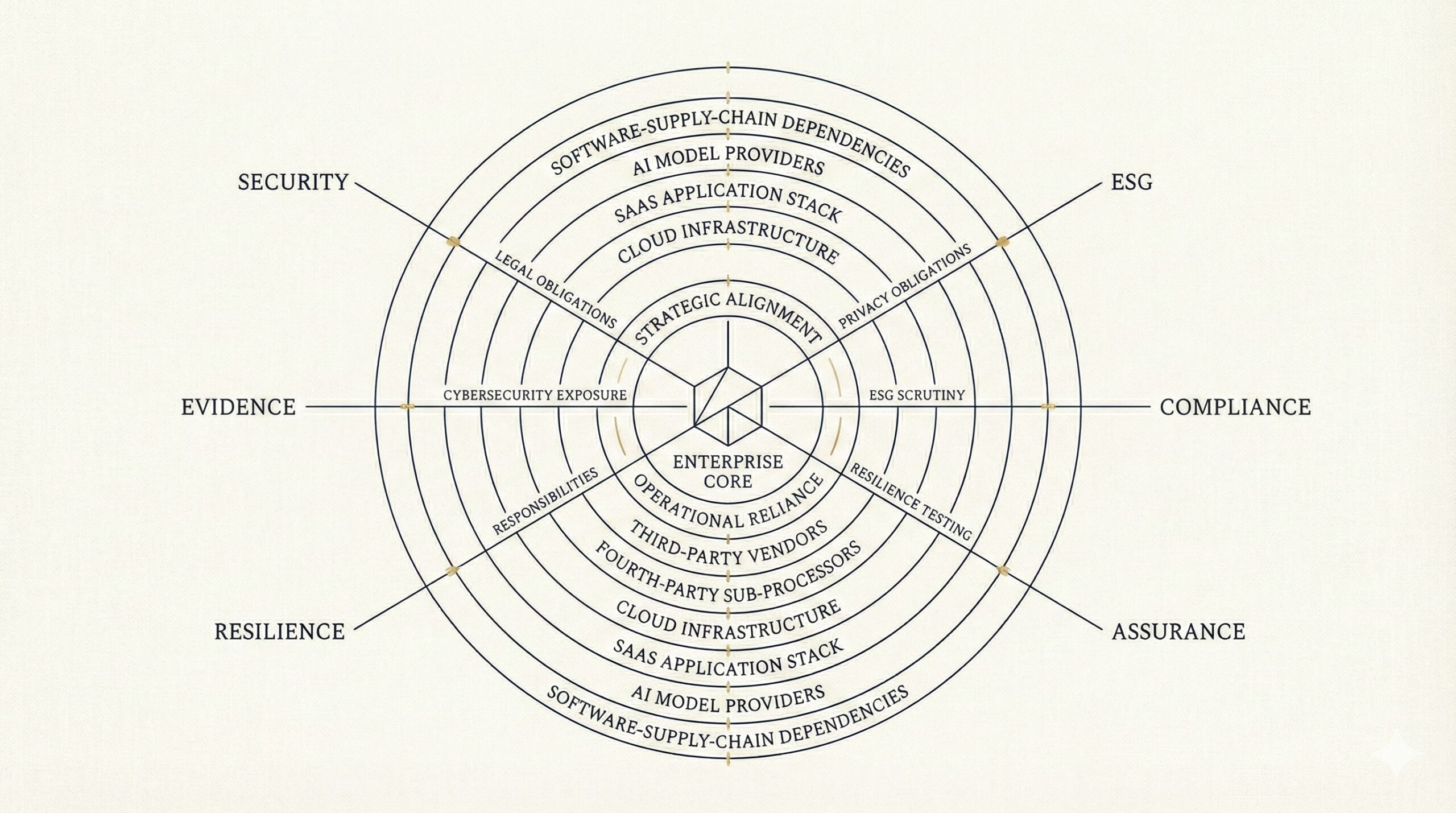
Modern organisations no longer operate as bounded legal entities. Core functions—data processing, cloud workloads, fraud controls, continuity, identity, logistics, AI models—are executed by external parties. These actors form an organisation’s true execution layer. They hold its performance, data, resilience, compliance and reputation.
Vendor ecosystems are therefore not ancillary commercial arrangements; they are the organisation’s extended operating model.
Third-party governance is enterprise governance.
Our role is to architect, embed, and evidence that governance to standards that withstand supervisory scrutiny, assurance testing, Internal Audit interrogation, and board-risk oversight.
The quadruple constraint: optimisation across four pillars
High-maturity organisations balance four imperatives simultaneously:
- commercial efficiency
- regulatory compliance
- ESG stewardship
- information-security and resilience
These are not competing pressures. They are inputs into the design of the operating model that governs the extended enterprise.
Our frameworks harmonise these dimensions through structure, control architecture, procurement logic, technology integration and evidence production.
Procurement target operating model architecture
We design and embed Procurement Target Operating Models (TOMs) that govern vendor ecosystems at a structural level. These TOMs unify:
- governance and authority
- cross-functional sourcing operations
- category strategy
- S2P lifecycle controls
- due-diligence and assurance
- contract governance
- evidence-ledgering
- ESG and sourcing ethics
- cyber and privacy alignment
- resilience and substitutability
- tooling and data flows
A TOM is not policy; it is a controlled architecture that binds procurement, legal, cyber, privacy, compliance, risk, ESG and Internal Audit into one oversight system.
Centre-led procurement governance structure
Mature enterprises progress from:
- decentralised (fast, but inconsistent)
- to centralised (controlled, but slow)
- to centre-led procurement models
Centre-led procurement centralises strategic controls, risk design, TOM oversight, and evidence generation while still allowing distributed execution for speed.
We design and formalise:
- procurement steering committees
- cross-functional sourcing teams (CFSTs)
- authority matrices
- escalation protocols
- decision-rights structures
- conflict-resolution logic
- reporting into executive and board-risk forums
This is operating-model governance, not advisory sentiment.
Source-to-pay lifecycle with integrated control gates
We embed governance logic directly into the S2P journey:
- demand identification
- spend analysis
- market scan
- risk tiering
- due-diligence and assurance
- weighted scoring
- contract governance and control clauses
- secure onboarding
- continuous monitoring
- renewal or exit with substitutability assessment
At defined control gates, we enforce checks on:
- cyber posture
- privacy operator duties
- ESG and human-rights
- solvency and insurance
- sanctions alignment
- AI provenance and data lineage
- continuity design
- exit-assistance and resilience
Procurement becomes a compliance and assurance mechanism, not a transactional process.
Category strategy and proportional governance
We apply category segmentation methodologies that distinguish:
- strategic
- bottleneck
- leverage
- non-critical
Governance intensity is proportional. Strategic and bottleneck suppliers are subjected to deeper assurance, contractual controls, resilience testing, ESG validation, security baselines and operator scrutiny.
Commodity and low-risk suppliers are governed lightly, or through automated digital checks. This is disciplined resource allocation, not blanket questionnaires.
Alignment with global governance frameworks
Our architecture draws its lineage from established frameworks:
- ISO 27001, 27701 and 27036 supplier controls
- NIST C-SCRM (SP 800-161) multi-tier risk architecture
- COSO ERM risk-appetite and oversight principles
- SOC 2 trust criteria
- POPIA and GDPR operator obligations
- DORA substitutability, concentration-risk and continuity mandates
- King V stakeholder and supply-chain ethics
Internal Audit, regulators and supervisory bodies use these frameworks to measure maturity. We design and map every element of the TOM accordingly.
Third-, fourth- and Nth-party dependency oversight
We govern beyond the contracted entity.
We map and control:
- third-party vendors
- fourth-party sub-processors
- deeper Nth-party lineage and hidden dependencies
This includes:
- data-flow lineage
- cloud and hosting layers
- software-supply-chain exposure
- AI model providers
- analytics suppliers
- code-library provenance and SBOM requirements
- cross-border transfer chains
- sanctions and geopolitical posture
- ESG exposure
Frameworks like DORA, NIST C-SCRM and ISO 27036 treat downstream parties as full risk nodes. So do we.
Inherent risk-tiering, due-diligence and assessment
Our weighted tiering models analyse:
- cyber maturity
- privacy compliance and operator duties
- solvency and financial health
- sanctions posture
- ESG and human-rights governance
- operational continuity
- ABC and anti-corruption
- insurance adequacy
- data sensitivity and system access scope
- AI provenance and modification chain risk
Tiering determines:
- contractual baselines
- evidence-depth
- testing frequency
- remediation urgency
- board reporting priority
- substitutability design
This is not questionnaire compliance. It is architectural risk engineering.
Contract-control architecture
We treat contracts as risk-control instruments.
Our clause catalogues include:
- DPA design
- mandatory security baselines
- sub-processor transparency and approval rights
- breach-notification duties
- cross-border safeguards
- data-retention limits
- ESG and ethical-sourcing standards
- anti-bribery and corruption obligations
- indemnities against control failure
- audit-rights and sampling
- evidence production
- exit-assistance and substitutability mechanisms
Controls must be embedded in legal commitments, not spreadsheets.
Continuous monitoring, assurance and evidence ledgering
Governance must be proven, not asserted.
We implement systematic evidence mechanisms that withstand audit inspection:
- recurring posture assessments
- ledgered due-diligence
- exception logging
- remediation trails
- concentration-risk mapping
- annual recertification
- contract-alignment validation
- scenario and continuity tests
- supervisory evidence sets
- assurance dashboards
- Internal Audit report-packs
Regulators and boards want evidence, not policies. We design the ledger.
Closing the paper-alignment gap
Most organisations possess:
- policies
- DPAs
- SOC 2 reports
- questionnaires
- ESG statements
Few achieve:
- operational control execution
- ledgered control evidence
- real continuity testing
- substitutability
- concentration-risk assessment
- Internal Audit defensibility
Our methodology closes the gap between documentary compliance and operational assurance.
Extended-enterprise maturity uplift
We drive uplift across distinct stages:
- ad-hoc — transactional procurement
- defined — policies and standard DPAs
- embedded — mapped chains, tiering, controls, evidence
- resilient — concentration mapping, monitoring, exit-design
- optimised — continuous sampling, audit alignment, scenario testing, board-reporting cadence
Maturity becomes measurable, defensible and demonstrable.
Board-level oversight and audit alignment
Our governance model speaks to:
- risk appetite
- three-lines-of-defence
- Internal Audit expectations
- regulator readiness
- audit evidence trails
- remediation governance
- DORA substitutability
- POPIA/GDPR operator duties
- ethical-sourcing scrutiny
- ESG indicators
Boards require visibility, proof, resilience, and defensibility. Our systems make those outcomes real.
AI, cloud and software-supply chain governance
Where vendors supply:
- AI models
- datasets
- cloud infrastructure
- code libraries
We extend governance into:
- model provenance and modification chains
- fundamental-rights assessments
- confidentiality of model internals
- SBOM lineage tracing
- algorithmic fairness
- exploit-path analysis
- data-governance and privacy duties
- breach-notification triggers
- continuity and substitution
AI supply chains are Nth-party risk. We operationalise that risk at contractual, technical and assurance levels.
Core deliverables
| Deliverable | Description of value |
|---|
| Procurement Target Operating Model (TOM) | Architected models aligned to ISO, NIST, SOC 2, POPIA, GDPR, DORA and King IV, governing vendor lifecycle, controls and assurance. |
| Steering committee and CFST design | Formal procurement governance structures that drive strategic alignment, conflict resolution, control execution and decision authority. |
| Risk-tiering matrices and weighted scoring models | Inherent risk analysis, proportional governance logic and procurement evaluation frameworks. |
| Due-diligence and assurance models | Evidence-led assessments, control sampling, posture testing, maturity visibility and audit defensibility. |
| Contract-control architecture | Comprehensive clause banks: DPAs, security baselines, sub-processor transparency, breach duties, cross-border controls, ABAC and indemnities. |
| Concentration-risk mapping | Visual and evidentiary mapping of vendor reliance, Nth-party lineage and systemic exposure for DORA and internal audit. |
| Exit-strategy and substitutability architecture | DORA-aligned models addressing organisational survivability, supplier failure response, continuity and substitution. |
| SBOM and model-provenance governance | Traceability of software components, code lineage, AI model provenance, modification chains and training-data integrity. |
| Internal audit and supervisory evidence sets | Control logs, exception diaries, remediation records, ledgered assurance and framework alignment proofs. |
| Board-risk dashboards | Executive reporting artefacts showing risk exposure, remediation progress, maturity trajectory and concentration posture. |
| Maturity uplift pathways | Structured roadmap to move from ad-hoc procurement to optimised continuous resilience, testing and assurance. |
Who we support
We support organisations where vendor failure would trigger:
- privacy or operator liability
- data breach exposure
- system compromise
- ESG or human-rights risk
- operational outages
- continuity loss
- financial or reputational damage
- regulatory action
- investor concerns
Our clients include:
- banks and financial groups
- infrastructure and telco operators
- health and medical environments
- logistics, mobility and transport networks
- cloud platforms and SaaS providers
- listed entities
- public-interest bodies
- AI deployers
Why ITLawCo
- we design operating models, not advisory reports
- we build control systems aligned with standards
- we treat contracts as enforcement vessels
- we enforce downstream transparency
- we operationalise resilience, substitutability and evidence
- we embed control logic into S2P, CLM and GRC tooling
- we produce audit-grade ledgers
- we uplift maturity, rather than patch policies
Engagement model
Get in touch
For enterprise-grade procurement TOM design, extended-enterprise governance, third-party risk architecture, assurance models and supervisory evidence frameworks, contact us.
FAQs
Extended-enterprise governance refers to the control systems, contractual architecture, due-diligence mechanisms and assurance measures that organisations apply to third-, fourth- and Nth-party suppliers who influence core operations. It treats vendor ecosystems as part of the organisation’s operating model, and embeds procurement, cyber, privacy, ESG and resilience controls into the vendor lifecycle.
Traditional procurement focuses on sourcing efficiency and cost. Third-party governance is a structural discipline rooted in ISO, NIST C-SCRM, DORA, POPIA/GDPR operator obligations, COSO and SOC 2 principles. It integrates due-diligence, risk-tiering, contractual controls, monitoring, evidence, and substitutability into the procurement Target Operating Model (TOM), turning procurement into a control environment.
Supply-chain exposure rarely sits at the first-layer vendor. Downstream service providers, software libraries, model assemblers, sub-processors, hosting platforms and data transfer infrastructures create legal, cybersecurity, privacy, ESG, sanctions and continuity vulnerabilities. Modern standards—including ISO 27036, NIST C-SCRM and DORA—treat fourth- and Nth-party dependencies as full risk nodes. High-maturity organisations map them, contract for transparency, and enforce controls.
POPIA and GDPR impose operator obligations on organisations that outsource data processing. Even if a processor handles the data, liability remains with the contracting party. Data-Processing Agreements, cross-border controls, sub-processor transparency, breach notification duties, due-diligence evidence, and security minimums are therefore legal artefacts — not optional commercial terms. Proper vendor governance operationalises this compliance.
It means that compliance is not accepted by assertion or policy claims. Controls must be proven through logs, samples, assessment records, remediation diaries, recertification cycles, contractual triggers, concentration-risk maps and alignment to frameworks. Internal Audit, regulators and board committees evaluate evidence trails, not vendor questionnaires.
A TOM defines the structural design of procurement governance. It sets decision rights, control checkpoints, authority matrices, cross-functional sourcing teams, Steering Committee oversight, S2P risk gates, contract-control standards, assurance cycles, framework alignment, tooling and evidence. Without a TOM, procurement remains transactional. With one, it becomes a regulated operating system.
Yes. DORA, ISO 27036 and emerging privacy and supervisory practices require organisations to ensure that critical services are not single-threaded. Exit-assistance clauses, data return and destruction pathways, substitutability architecture, continuity mapping, and vendor-failure response mechanisms are all resilience doctrines, not optional terms.
Core frameworks include ISO 27001, 27701, 27036, NIST C-SCRM (SP 800-161), SOC 2, COSO ERM, POPIA/GDPR operator obligations, DORA operational resilience mandates, King V ethics and supply-chain principles, and FRIA logic for AI model provenance. These standards define control expectations, operational duties, assurance depth, contractual clauses, and evidence outcomes.
Concentration-risk measures systemic dependence on a small cluster of suppliers or sub-processors, typically in strategic or critical categories. If one fails, the organisation’s operations, data environments, compliance, ESG posture, resilience and continuity may collapse. DORA and NIST C-SCRM require monitoring, mapping and substitutability specifically to mitigate concentration exposure.
By building systems that produce audit-grade evidence, ledgered controls, control testing trails, remediation logs, risk-tiering models, contractual traceability, alignment proofs, framework mapping and resilience outcomes. Our architecture supports Internal Audit inspection, supervisory queries, risk-committee reporting, ESG accountability, and POPIA/GDPR operator defence. The output is not consulting reports, but defensible governance systems.
Publication details
Author: ITLawCo’s TPRM Team
Jurisdictional lens: South Africa with GDPR-linked cross-border exposure
Last updated: December 2025
Disclaimer
This page does not constitute legal advice. Governance must be tailored to sectoral exposure, regulatory obligations, data sensitivity, operating dependencies and risk appetite.