
Your website’s terms of use are worth getting right.
A poorly drafted agreement isn’t just a legal inconvenience; it’s an unenforceable one. We draft website terms that hold up wherever your business operates and wherever your users are.
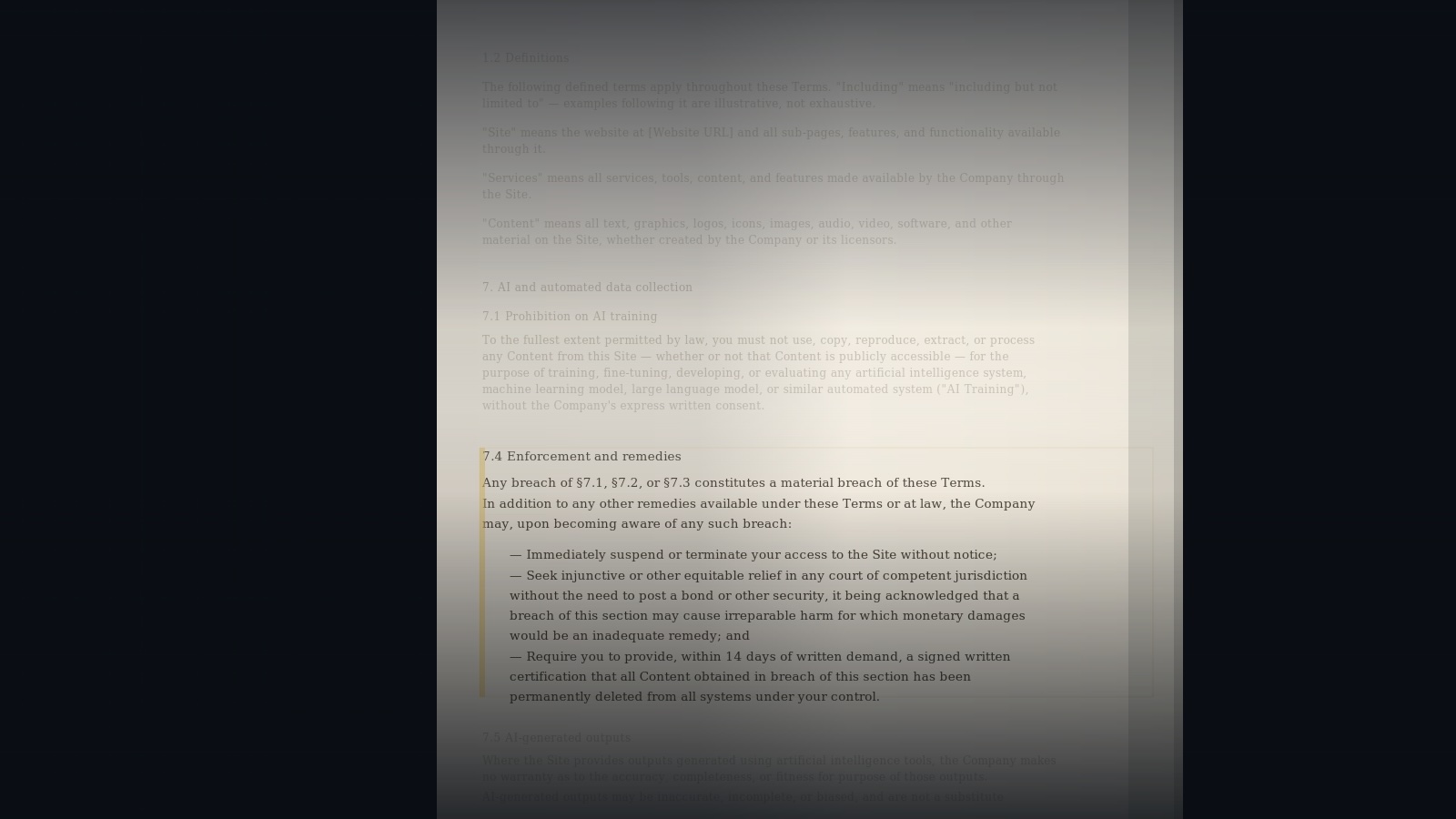
A poorly drafted agreement isn’t just a legal inconvenience; it’s an unenforceable one. We draft website terms that hold up wherever your business operates and wherever your users are.
Yes, and the reasons go beyond liability protection. Depending on your jurisdiction and the nature of your platform, your website terms of use may need to address:
60% of browsewrap challenges succeed when notice is inadequate
3+ overlapping legal frameworks typically apply to a single website operating across multiple jurisdictions
14 days — the cancellation window consumers may acquire if required disclosures are missing, under frameworks including South Africa’s ECTA and the EU’s distance-selling rules
0 generic templates are drafted with your jurisdiction, platform, and user base in mind
Most websites have terms. Few have terms that would survive a challenge. Here is what inadequate drafting actually costs.
A user scrapes your content, trains an AI system on it, and you go to court, only to discover your browsewrap was never properly constituted. Courts in the US, EU, UK, and beyond have invalidated agreements where users had no reason to know terms existed.
Whether it is GDPR in Europe, POPIA in South Africa, the CCPA in California, or another framework in your market, data protection law imposes duties that a well-drafted set of terms must acknowledge and that generic templates rarely address correctly.
Without an express prohibition tied to remedies—injunctive relief, material breach designation, deletion certification requirements—a clause that merely says “no scraping” gives you a paper position, not an enforceable one. After Meta Platforms v. Bright Data (N.D. Cal. 2024), the standard has shifted.
A flat liability cap that doesn’t distinguish free users from paying users, and that doesn’t specify cumulative and not “per-incident”, leaves you exposed to cascading claims from a single technical incident. Courts have enforced per-incident readings where the cap was ambiguous.
“Continued use constitutes acceptance” is unenforceable in most US states and faces serious scrutiny in EU and other consumer-protection contexts. We draft amendment regimes with advance notice periods, active rejection rights, and version archives—the architecture that courts actually uphold.
Incorporating your privacy notice by reference into your terms of use restricts your right to update it without triggering the amendment procedure, and adds a layer of contract liability if you breach it. Decoupling them correctly requires a contractual necessity bridge clause.
Courts have frequently found browsewrap agreements unenforceable absent clear and conspicuous notice to users ~ Standard position across US, EU, UK, and common law jurisdictions. So the baseline your terms must clear
We draft to the full stack: legal substance, jurisdictional compliance, and contractual precision. Here is what that means in practice.
A website is global by default. Your terms of use need to work wherever your users are, not just where you are incorporated.
We build jurisdiction-toggle architecture into every set of terms. That means the same document can address GDPR for your EU users, POPIA for your South African users, CCPA for Californians, and consumer protection requirements across common law markets — without becoming unreadable.
Europe: GDPR contractual necessity, DSA transparency obligations, Brussels I consumer jurisdiction rules, age threshold compliance.
United States: State consumer protection carve-outs, COPPA age compliance, copyright agent registration, FTC negative option rules for subscriptions.
South Africa: POPIA Responsible Party designation, CPA compliance clause, ECTA statutory disclosure block.
UK and Commonwealth: Post-Brexit data adequacy considerations, Consumer Rights Act compatibility, distance-selling obligations.
Our terms of use are developed against primary legal sources and leading reference frameworks as well as current browsewrap jurisprudence from US, EU, UK, and South African courts. That means no “shall” where simple present is the correct verb structure. No “indemnify and hold harmless” where “indemnify” is sufficient. Precision at the clause level is not pedantry; it is what courts read.
A fixed, predictable process. No open-ended engagement.
Off-the-shelf templates are drafted for no one in particular. That is their defining limitation.
| Issue | Generic template | ITLawCo terms |
|---|---|---|
| Jurisdiction-specific statutory compliance | Not addressed | Frameworks identified and drafted to |
| Consumer rights conspicuousness notices | Not addressed | Named clauses drawn to consumer’s attention |
| AI training prohibition | Absent or toothless | Material breach, injunctive relief, deletion certification |
| Liability cap structure | Flat, ambiguous, no per-incident clarification | Tiered (free / paid), cumulative and not per-incident |
| Amendment enforceability | “Continued use = acceptance” | Advance notice, written rejection right, version archive |
| Privacy policy relationship | Incorporated by reference | Decoupled with contractual necessity bridge |
| Indemnity mechanics | One paragraph, no procedures | Notice, control of defence, settlement restrictions, cooperation |
| Suspension and termination | “Without notice, at our discretion” | Tiered regime, jurisdiction-defensible, post-suspension notification |
| Verb structure precision | “Shall” throughout | Obligation, policy, condition — correct structure for each |
Possibly not, but you should know what they cover and what they don’t. The most common gaps we find are: no AI training prohibition, ambiguous liability caps, amendment clauses that courts will not enforce, missing consumer rights notices required by the jurisdictions you operate in, and privacy notices incorrectly incorporated by reference. We offer a terms review service that gives you a prioritised remediation plan before you decide whether a full redraft is necessary.
A browsewrap binds users by continued use of your site, without requiring any affirmative action. A clickwrap requires the user to actively click “I agree” before proceeding. Browsewraps are appropriate for general website terms; clickwraps are legally safer for high-stakes provisions, e.g., arbitration clauses, AI training restrictions, subscription auto-renewal terms, and significant liability limitations. We advise you on which provisions require clickwrap treatment and design the notice architecture accordingly.
Usually, yes, if the terms are structured correctly. We build jurisdiction-toggle architecture into complex international terms, so the document addresses the applicable framework in each market without becoming a patchwork of contradictions. For very different regulatory environments, we may recommend modular addenda rather than a single monolithic document.
Partly. And the way this is drafted matters considerably. Processing genuinely necessary for the performance of your services can rely on contractual necessity as its lawful basis under GDPR, POPIA, and equivalent frameworks. But if your privacy notice is incorporated by reference into your Terms, you cannot update it without triggering the terms’ amendment procedure. The correct approach is to decouple them with a contractual necessity bridge clause. This affects your ability to adapt your data practices as your business grows.
Standard turnaround for a full set of terms (core terms plus any applicable modules) is 10 business days from briefing sign-off. A terms review takes 5 business days. We work on a fixed-fee basis: scope, price, and turnaround are agreed in writing before any work begins. Contact us for a scoping call and we will confirm fees for your specific requirements.
ITLawCo is an information technology law practice advising digital businesses on the legal frameworks that govern their operations: data protection, cloud and SaaS agreements, software licensing, IT contracts, and website legal compliance.
We work with clients across jurisdictions—from early-stage platforms to established enterprises—who need legal documents drafted to the standard their business and their users deserve. We do not recycle precedents; we draft to your specific platform, user base, and regulatory exposure.
Book a scoping call. We will assess your site, identify your exposure, and tell you exactly what you need—before you commit to anything.
Professional disclaimer: This page provides general information for informational purposes only. It does not constitute legal advice and does not create an attorney-client relationship. Legal requirements vary by jurisdiction, business model, and the specific circumstances of each client. Consult a qualified legal professional in your jurisdiction before publishing or relying on any website terms of use.