The modern wine industry collects extensive personal data across direct-to-consumer sales, wine clubs, hospitality, digital marketing, and precision viticulture. This includes identity and contact information, transactional and behavioural data, age-verification records, digital interaction data, and emerging operational data from smart-vineyard technologies. Understanding what data is collected—and why—is essential for regulatory compliance, cybersecurity resilience, and the preservation of customer trust in the global wine economy.
Why this matters
Wine today exists in two worlds: the vineyard and the database. Modern wineries operate as relationship-driven data ecosystems, where long-term customer connection, regulatory compliance, and operational intelligence depend on structured personal information.
Clear visibility of personal data enables:
- Responsible governance and lawful processing
- Trusted, personalised customer relationships
- Protection against cybersecurity and regulatory risk
- Sustainable brand credibility in a digital marketplace
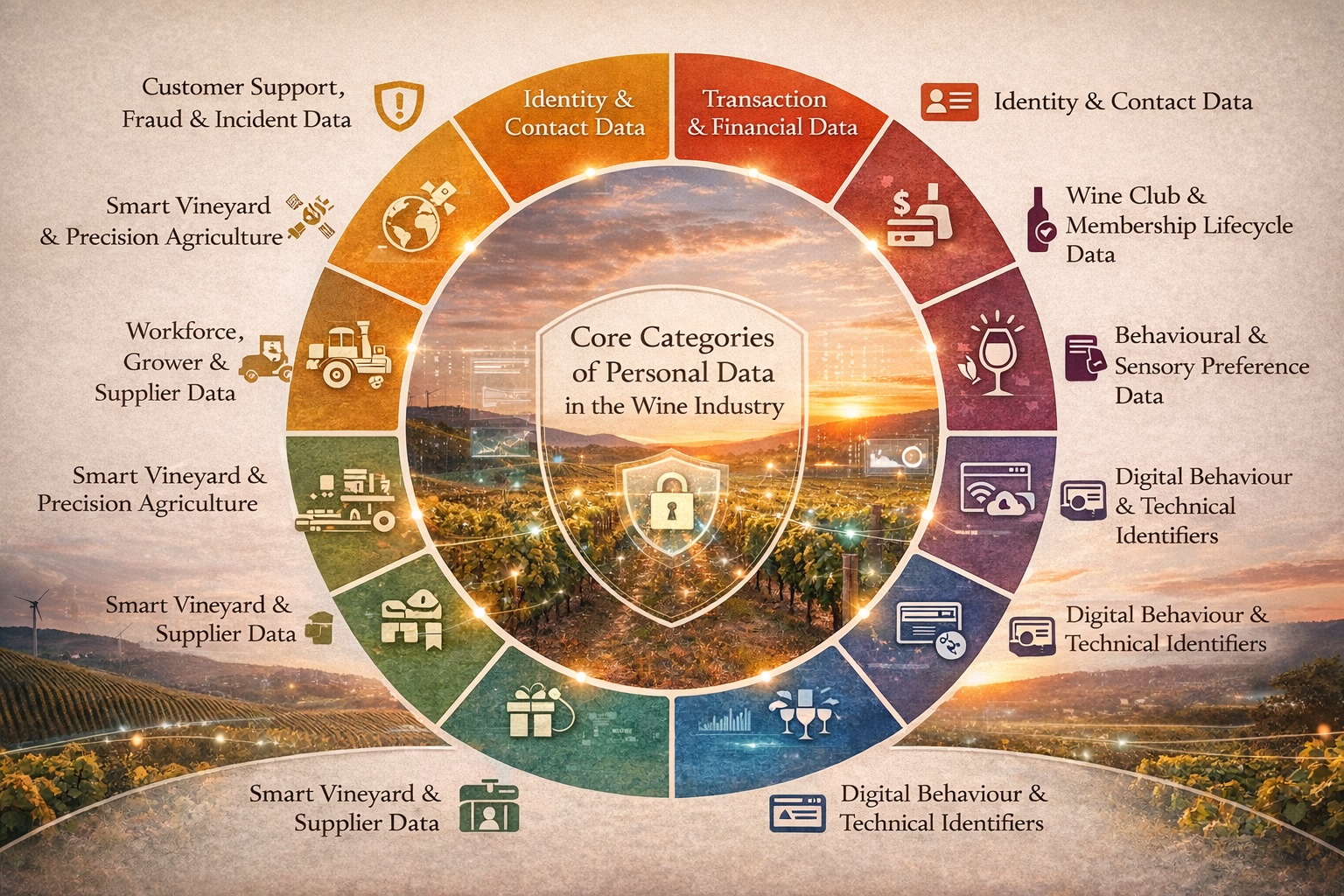
Core categories of personal data in the wine industry
1. Identity and contact data
The foundation of all customer relationships:
- Full name and title
- Email and telephone
- Billing and shipping address
- Date of birth / age verification
- Account preferences and identifiers
Used for fulfilment, regulatory compliance, and customer recognition.
2. Transaction and financial data
Wine purchases form a behavioural narrative over time:
- Purchase history and vintage selection
- Payment tokens and billing records
- Average order value and lifetime value
- Subscription and recurring payment history
This data enables forecasting, segmentation, and revenue modelling.
3. Wine club and membership lifecycle data
Wine clubs generate deep relational datasets:
- Membership tier and tenure
- Customisation and varietal preferences
- Engagement and churn signals
- Loyalty and reward data
These insights support personalised experiences and retention strategies.
4. Behavioural and sensory preference data
Wineries increasingly track the shape of taste:
- Aroma and flavour preferences
- Acidity, tannin, sweetness, and body tolerance
- Lifestyle and travel indicators
- Event and tasting engagement
This data informs product positioning, education, and targeted communication.
5. Digital behaviour and technical identifier data
Every digital interaction leaves a technical footprint:
- Cookies and tracking identifiers
- IP address, device, and browser metadata
- Website navigation and engagement patterns
- Marketing and campaign interaction data
Used for analytics, retargeting, and customer journey optimisation.
6. Hospitality and tasting room data
The physical experience remains a primary data gateway:
- Reservations and guest lists
- Personal milestones and preference notes
- Dietary or accessibility information
- Visitor type and conversion metrics
This data captures both behaviour and emotional connection.
7. Gifting, referral, and ecosystem data
Wine extends beyond the purchaser:
- Gift recipient identity and delivery data
- Milestone and event tagging
- Referral and affiliate identifiers
- Partner attribution metrics
This expands the winery’s relational ecosystem.
8. Workforce, grower, and supplier data
Operational continuity depends on:
- Employee and seasonal workforce records
- Grower and supplier financial and contractual data
- Training and compliance information
This category carries heightened operational and security sensitivity.
9. Smart vineyard and precision agriculture data
Digital viticulture introduces new data realities:
- GPS-linked worker or vehicle data
- Drone and surveillance imagery
- IOT sensor activity linked to human operations
- Access and biometric systems
Even operational data may become personal where individuals are identifiable.
10. Customer support, fraud, and incident data
Risk and quality management produce:
- Complaint and dispute records
- Fraud indicators and anomaly detection
- Delivery and service incident logs
- Communication history
These support resilience and legal defensibility.
Real-world use cases
- Wine club personalisation: Preference and behavioural data drive curated shipments and retention modelling.
- Tasting room conversion: Visitor data transforms anonymous guests into long-term members.
- Predictive DTC marketing: Digital behaviour enables targeted communication and lifecycle automation.
Emerging strategic data domains
The scope of wine data continues to expand:
- Proprietary winemaking and intellectual property data
- Supply chain provenance and anti-counterfeit systems
- Blockchain traceability and authentication
- AI-driven predictive analytics
- Climate and agricultural modelling datasets
Data is increasingly the strategic core of modern wine operations.
How ITLawCo supports the wine industry
| Wine industry need | Typical risk | How ITLawCo helps | Outcome |
|---|---|---|---|
| Data mapping | Hidden data exposure | End-to-end lifecycle mapping | Governance clarity |
| Profiling governance | Regulatory exposure | Ethical personalisation frameworks | Safe engagement |
| Age verification | Over-collection risk | Data minimisation architecture | Compliance |
| Digital marketing | Consent and tracking risk | Marketing and cookie governance | Trust |
| Hospitality data | Sensitive data exposure | Privacy-by-design | Controlled processing |
| Vendor risk | Third-party exposure | Vendor governance and DPAs | Supply-chain resilience |
| Security | Cyberattack risk | Incident and breach readiness | Continuity |
| Global compliance | Multi-law complexity | Harmonised compliance frameworks | Stability |
| Smart vineyard | Emerging tech risk | Privacy impact assessments | Responsible innovation |
| Digital trust strategy | Reputation risk | Governance architecture | Long-term credibility |
Key privacy and governance implications
Responsible wine organisations must ensure:
- Transparent and lawful processing
- Data minimisation and retention discipline
- Protection of sensitive and behavioural data
- Governance of marketing and digital tracking ecosystems
- Secure cross-border data management
FAQs
What personal data do wineries collect?
Identity, transactional, behavioural, digital, hospitality, workforce, and operational data linked to identifiable individuals.
Why do wine clubs collect extensive data?
To personalise experiences, manage allocations, predict churn, and build long-term customer relationships.
Is vineyard technology personal data?
Where operational data links to identifiable workers or individuals, yes.
Do wineries collect sensitive data?
Sometimes: including allergy, biometric, or detailed profiling data.
Why must wineries understand their data collection?
Because privacy compliance, cybersecurity, and customer trust depend on clear data governance.
End thoughts
Wine has always depended on trust: in the land, the maker, and the moment of opening. In the digital age, that trust extends beyond the cellar into the architecture of data. The modern winery must steward personal information with the same discipline applied to vine and barrel. For the integrity of the wine in the bottle must now be matched by the integrity of the data that surrounds it.