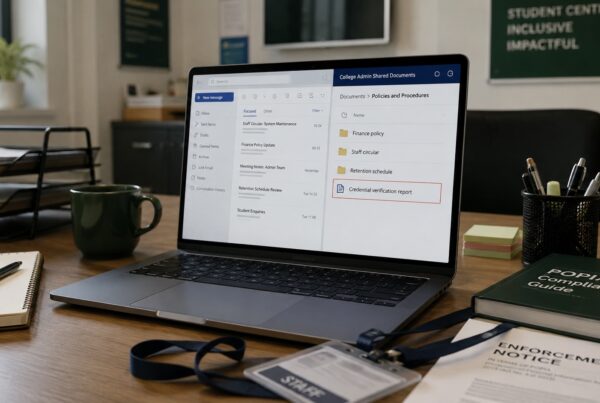
Corporate email is central to business operations. Inboxes often contain deliverables, contracts, IP, strategic discussions, compliance records, and client communications. When an employee is still working—and especially when they leave suddenly, resign, or are dismissed—organisations may need access to that mailbox to ensure continuity, secure work product, or resolve risk.
In South Africa, inbox access is not a mere IT action. It is a legally regulated event.
Two statutes govern it directly:
- RICA — whether interception is permitted at all; and
- POPIA — what may be done with personal information inside the inbox once accessed.
Two other laws—ECTA and PAIA—sit at the margins. Neither grants interception or creates POPIA lawful grounds. They reinforce evidentiary validity (ECTA) and transparency rights (PAIA), but they do not authorise or legitimise inbox access.
1. RICA: The gateway test to unlock an inbox
RICA’s default rule prohibits interception of communications. Corporate-inbox access counts as “interception”.
However, section 6 creates a business-interception exception. An employer may access inbox communications only if all the following conditions are met:
Business connection
The communications relate to the organisation’s operations, business transactions or functions.
System-controller authorisation
The interception is effected by or with the consent of the authorised system controller (e.g., CIO, security head, or CEO delegate).
Statutory permitted purpose
Interception is undertaken for permissible purposes, including:
- establishing facts,
- detecting misuse,
- system-operation effectiveness,
- security integrity or fault detection.
Communications transmitted over the employer’s system
The email is sent, received or stored using the employer’s communication infrastructure (server, cloud tenancy, domain, laptop).
Prior notice to users
Reasonable efforts were made to inform staff that communications may be monitored or accessed (contracts, policies, log-in banners, code of conduct, awareness training).
If these conditions are not satisfied, inbox review may be unlawful interception.
RICA, however, stops at the point of access. It does not address:
- how inbox content may be handled,
- the scope of review,
- storage or retention, or
- future use of any personal information found.
Those aspects fall to POPIA.

2. POPIA: What you may do once inside the inbox
If the instant inbox content includes personal information, even incidental chats, POPIA applies.
POPIA requires that the organisation:
- identify a lawful basis for processing under section 11,
- process only for a legitimate and defined purpose,
- implement minimality,
- respect dignity and reasonableness,
- secure any extracted data,
- and erase or de-identify personal information once no longer required.
RICA ≠ POPIA lawful basis
RICA simply confirms that the initial interception is not a criminal act. It does not replace POPIA’s lawful-processing test.
The employer must independently establish a POPIA ground, typically:
- legitimate interests (business continuity, IP recovery, legal compliance, investigation),
- legal obligation (where applicable), or
- exercise/defence of a right (e.g., litigation, regulatory enquiry).
Consent is generally weak in employment, and contractual necessity may apply only during active employment.

3. Accessing inboxes during employment
Inbox access is usually easier to justify during employment because the business purpose remains live.
Examples of legitimate POPIA-aligned purposes include:
- completing project delivery,
- meeting client obligations,
- retrieving key documents,
- ensuring corporate governance oversight,
- responding to compliance obligations,
- investigating suspected misuse or security breach.
If inbox access is:
- RICA-compliant, and
- POPIA-justified,
then narrowly scoped review may be lawful.
But POPIA still demands restraint:
- searches must be limited,
- access must be authorised,
- personal content must be avoided or deleted,
- misuse for HR assessments or curiosity is impermissible.
Employees do not abandon privacy rights merely because the mailbox belongs to the organisation.
4. Accessing inboxes after employment ends
Once employment terminates, POPIA’s purpose-limitation becomes decisive. Much of the personal information in the inbox was collected to support the employment relationship, which no longer exists. That purpose may fall away, narrowing what remains justifiable.
Inbox access may still be lawful if strictly necessary for:
- handover,
- business continuity,
- work-product recovery,
- fulfilment of contractual obligations,
- intellectual property protection,
- legal investigation,
- or defence of rights.
However, access must be:
- narrowly defined,
- limited to specific searches,
- temporary,
- audited,
- and shut down once the purpose ends.
Wholesale access, indefinite retention, post-employment rummaging, or searching for useful insights all fail POPIA’s lawfulness and minimality tests. Once the continuity purpose is met, personal content must be purged and access terminated.

5. Personal messages: minimal intrusion, strict deletion
Corporate email systems often allow occasional personal use. That reality does not waive privacy and dignity rights.
When personal messages surface during lawful access:
- do not read more than necessary,
- exclude irrelevant correspondence from review,
- segregate content,
- apply redaction where possible,
- delete when no lawful purpose exists.
Under POPIA, personal content cannot be retained or re-purposed for unrelated uses.

6. Other electronic communications channels (Teams, WhatsApp, VOIP, Devices)
Although this article focuses on inbox access, the same legal principles apply to other business communication channels, including:
- Microsoft Teams
- Slack
- VOIP recordings
- SMS sent from corporate devices
- Chat threads stored on enterprise systems
- Business-registered WhatsApp accounts
- Corporate mobile phones and SIM cards
- Call-centre recordings
- Enterprise telephony logs
- Internal collaboration tools
- M365 chat storage
If these channels form part of the employer’s telecommunications environment, the access or review of personal information transmitted through them still qualifies as interception under RICA, and still triggers POPIA’s lawful-processing, minimality, purpose-limitation, transparency and retention requirements.
In practice, these channels often contain more personal content than email: voice messages, informal conversations, family discussions, images, photos, or voice recordings. This intensifies POPIA’s proportionality demands.
Access, therefore, should be incremental:
- review metadata, timestamps, subject references or participant lists first,
- and escalate to content only if strictly necessary.
Where an employer issues business devices or numbers, the RICA and POPIA tests apply fully. Where corporate activities are channelled through personal numbers, BYOD phones or private WhatsApp accounts, the lawful justification becomes significantly weaker, because communications may not travel over the employer’s system and personal life is deeply intertwined. Personal communications found on these channels must be isolated and deleted unless they form part of the narrowly defined business purpose.
Across all channels, the rules remain constant:
- RICA governs lawful access,
- POPIA governs lawful processing,
- minimality and purpose-limitation prevail,
- irrelevant personal content must be erased,
- and access must cease when the purpose ends.
7. Best-practice safeguards that align with POPIA and RICA
| No. | Safeguard principle | Practical implementation guidance | POPIA/RICA alignment |
|---|---|---|---|
| 1 | Reduce reliance on personal inboxes/chats for continuity | Use shared drives, structured handovers, team mailboxes, collaborative platforms, and access-controlled repositories for business records. | Minimises processing volume and incidental personal data exposure (POPIA: minimality). |
| 2 | Adopt a written inbox and communications access policy | Clearly set out triggers, authorisation chain, lawful purposes, retention rules, handling of personal content, and logging requirements. | RICA: prior notice to users; POPIA: transparency and accountability. |
| 3 | Do not rely on employee consent | Avoid consent due to power imbalance. Use legitimate interest, legal obligation, or exercise/defence of rights as lawful grounds. | POPIA s11 lawful basis; ethical processing principle. |
| 4 | Apply incremental access before opening full content | Start with metadata, subject lines, keywords, date filters and sender/recipients before reviewing actual email or message contents. | POPIA: minimality, proportionality, purpose-limitation. |
| 5 | Segregate and delete personal content | Do not read more than necessary. Redact or remove messages unrelated to the lawful business objective. Never repurpose personal information. | POPIA: purpose-limitation, data minimisation, privacy and dignity. |
| 6 | Define system-control authority and keep logs | Require system-controller approval, written request forms, audit logs, reviewed scope limitations, and recorded rationale for access. | RICA: system-controller authority; POPIA: accountability and documentation. |
| 7 | Enforce retention sunset and deletion | Destroy inbox or chat content once the continuity or investigative purpose concludes. Extract only business-critical data and erase the rest. | POPIA: storage-limitation, minimality, retention–deletion obligations. |
| 8 | Train staff on lawful monitoring and privacy expectations | Include mailbox access protocols in security awareness programmes and employment onboarding. Reinforce dignity, purpose-limitation, and restraint. | POPIA: openness, fairness and processing awareness requirements. |
These eight safeguards represent the operational expression of POPIA’s minimality and purpose-limitation conditions, and RICA’s business-interception requirements. They form the minimum governance basis for lawful mailbox or communication-channel review.

8. ECTA’s limited but useful role
Once content has been lawfully accessed under RICA and POPIA, the Electronic Communications and Transactions Act (ECTA) matters.
ECTA:
- recognises emails, messages, logs and data as electronic records,
- confirms their admissibility,
- allows them to serve as documents,
- and validates evidential use.
It does not authorise interception or processing. Its role begins only once access is already lawful.
9. PAIA’s narrow after-the-fact role
PAIA (Promotion of Access to Information Act) does not authorise inbox or communications access.
It becomes relevant only if an employee, union or regulator later requests internal records needed to exercise or protect rights in a dispute. It supports transparency, not interception.
RICA and POPIA remain the only core authorisation frameworks.
10. Practical governance questions for employers
Before accessing any inbox, chat channel, VOIP record or corporate device log, ask:
- Do we have a precise and legitimate business reason?
- Do we satisfy RICA’s business-interception exception?
- What is our POPIA lawful basis?
- Can we target narrowly and review incrementally?
- How do we handle personal content?
- Who approves access and keeps records?
- How long will access last?
- How will we prove compliance if challenged?
If any answer feels defensively weak, pause.

How ITLawCo helps
| Capability | What ITLawCo Delivers | Outcome |
|---|---|---|
| RICA-compliant interception frameworks | Drafting system-controller mandates, authorised interception protocols, gateway assessments and internal approvals aligned with RICA’s business-interception exception. | Ensures mailbox, chat-channel and device review is lawfully accessed, documented, and defensible. |
| POPIA lawful-processing analysis | Identifying the correct section 11 ground for processing inbox content, running minimality tests, and applying purpose-limitation, proportionality, and deletion obligations. | Guarantees processing of personal information remains lawful, necessary and narrowly scoped. |
| Inbox-access and monitoring policies | End-to-end policy architecture, including mailbox-access protocol, monitoring notices, employment-contract clauses, and channel-specific governance controls. | Establishes a transparent, privacy-aligned operational environment for communications access. |
| Communications-channel governance | Applying RICA+POPIA compliance to Teams, WhatsApp Business, VOIP logs, corporate SIM cards, device audits, and enterprise messaging infrastructure. | Provides uniform, repeatable compliance doctrine across all digital channels and systems. |
| Dispute and enforcement readiness | Preparing defensibility files, logging templates, authorisation registers, legal arguments and regulator-engagement scripts in the event of complaints or litigation. | Reduces legal exposure, strengthens audit trails, and enables resilient regulatory positioning. |
| Policy training and staff workshops | Facilitated training sessions on inbox-access rules, monitoring boundaries, duties under POPIA, and the handling of personal content during lawful interception. | Drives compliant behaviour, awareness and dignity-centred processing culture across the organisation. |
ITLawCo supports organisations in responsibly accessing corporate inboxes and other communications systems by combining RICA gateway compliance with POPIA lawful-processing discipline, operational governance standards, and defensibility under regulatory scrutiny.
Get in touch with us
FAQs
Can an employer access an employee’s inbox in South Africa?
Yes, but only when RICA permits interception and POPIA separately provides a lawful processing ground.
Does compliance with RICA automatically satisfy POPIA?
No. RICA unlocks the inbox. POPIA governs how personal information may be handled once inside.
Is inbox access easier during employment?
Generally yes, because the business purpose remains active. Minimality and purpose-limitation still apply.
Is inbox access after dismissal automatically unlawful?
No, but justification is stricter. Access must be narrow, necessary, temporary and linked to a lawful POPIA ground.
Do these principles apply to Microsoft Teams, Slack, WhatsApp Business or corporate mobile devices?
Yes. If communications travel over the employer’s system and personal information is accessed, RICA and POPIA apply. Personal content must be minimised, and access must cease once the lawful purpose ends.
What if personal messages are found?
If irrelevant, they may not be read, retained or re-purposed. They must be segregated, redacted or deleted.