Can I record the police? The short answer: yes, if you follow the law.
The camera, the badge, and the Constitution
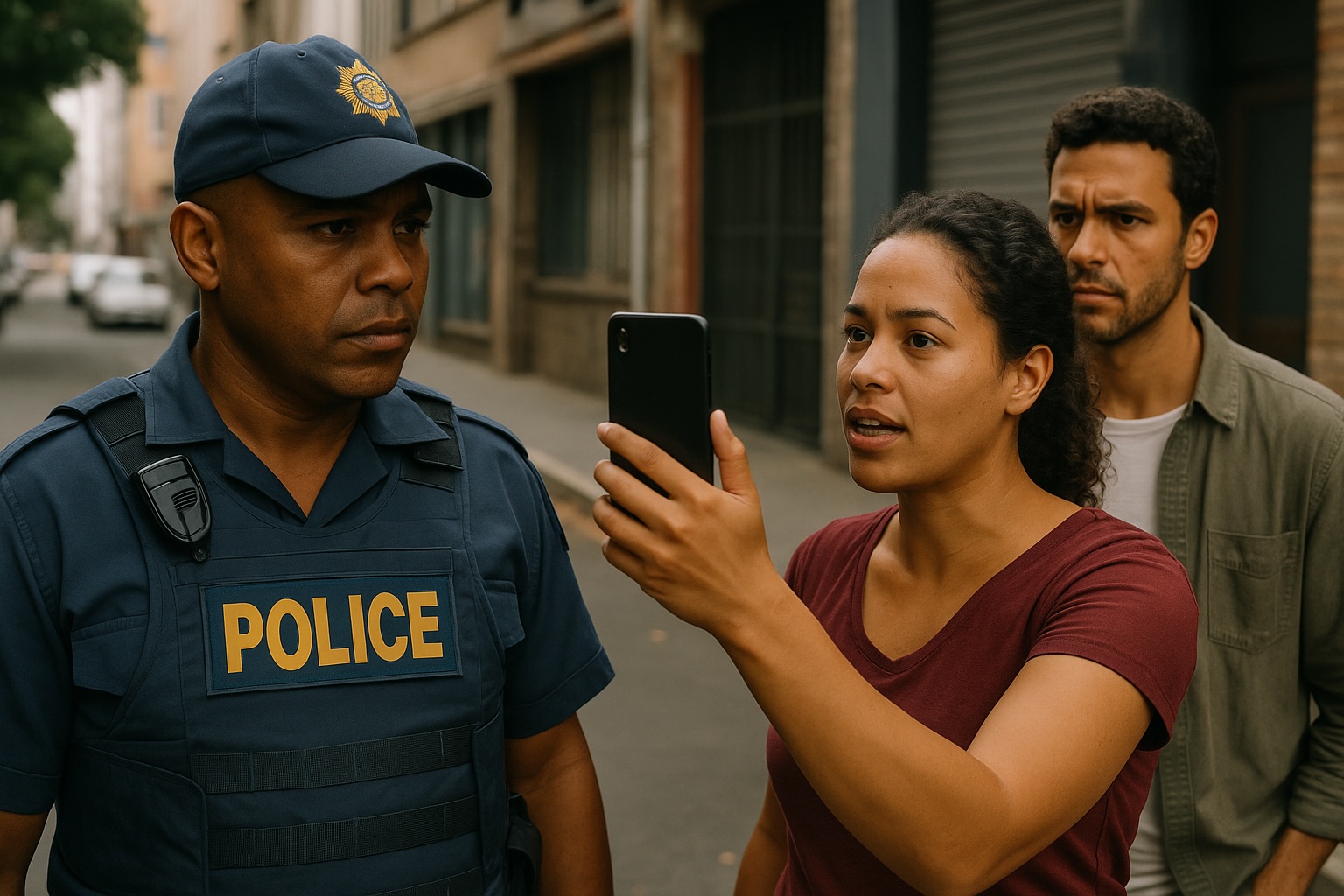
South Africa’s Constitution was never meant to be whispered about in dark corners of bureaucracy, it was meant to be filmed in action. So when a citizen points a phone at a uniformed officer, it’s not rebellion, it’s democracy doing what it does best: keeping score.
The right to record the police is not about paranoia. It’s about proof. It is how citizens remind the State that memory in a constitutional democracy is not a privilege of power, it’s a public right.
And yet, for years, the question lingered: Can I actually do this? In 2025, the law finally stopped dodging the camera.
The Jacobs case: When the State blinked first
Enter Mr Jacobs, an attorney, a roadblock, and one inconvenient cellphone. He filmed a police operation outside his home. They arrested him for it. The High Court’s reply was surgical: recording the police is not a crime.
The Court awarded Jacobs R250 000 in damages and, in doing so, issued a quiet revolution, the moment South Africa’s judiciary looked the State in the eye and said, “You are not allergic to sunlight.”
It wasn’t just about Jacobs. It was about the right of every South African to say, “If you wield power in my name, I’m allowed to watch you do it.”
The Constitution: Three simple weapons
The right to record sits on a tripod of constitutional guarantees:
- Freedom of expression (section 16), because truth needs witnesses.
- Access to information (section 32), because justice needs evidence.
- Accountability in public administration (section 195), because government should never fear its own reflection.
The camera doesn’t just document misconduct, it deters it. It’s not an act of aggression, it’s a civic ritual of remembrance.
RICA: The soundtrack of legality
Behind every video is sound, and sound has its own statute.
The Regulation of Interception of Communications and Provision of Communication-Related Information Act 70 of 2002 (RICA) starts with a firm no: you may not intercept a private conversation.
Then it gives the crucial but: section 4(1), if you’re a party to the communication, you may record it. No consent required.
That’s the “one-party-consent rule”. If you’re talking with the police, you may record the exchange. You’re not eavesdropping, you’re documenting your own experience.
Law enforcement, ironically, has stricter rules. They need internal or judicial clearance to record you. That asymmetry is deliberate. Parliament knew that unchecked power needs more mirrors than microphones.
POPIA: The visual etiquette of accountability
Now for the visuals, the faces, badges, and body language. POPIA enters the frame.
Filming a uniformed officer counts as processing personal information, but that doesn’t make it illegal. Consent is only one path, public interest is another, and a far stronger one here.
- Legitimate interest: you’re protecting yourself or preserving evidence.
- Public-interest exemption (section 37): recording promotes transparency, the detection of offences, and compliance with the law.
A police officer performing a public duty has a diminished expectation of privacy. Their badge is not a veil, it’s a beacon.
Still, when posting footage online, decency demands discretion. Blur bystanders. Protect victims. Accountability isn’t license for voyeurism.
The limits: When your camera becomes a weapon
Every right has a radius. Cross it, and you become the problem.
Filming must never morph into obstruction. Stand back. Don’t bark instructions. If an officer tells you to move for safety, move, and keep filming from where it’s safe.
Private spaces raise a different rulebook. Filming inside homes or medical settings demands caution; dignity is still law, even when the State isn’t.
Think of it as the choreography of democracy: you can record the dance, but you don’t get to trip the dancer.
When police delete your democracy
Sometimes, authority panics. Phones are grabbed, videos deleted. That’s not just arrogance, it’s illegality.
Under section 22 of the Criminal Procedure Act 51 of 1977, seizure without a warrant is permitted only in narrow emergencies. Deleting footage crosses from misconduct to constitutional vandalism.
It violates your right to privacy, your right to property, and your right to access information.
If it happens, you can (and should) seek damages. Jacobs did, and won.
The courtroom encore: admissibility
What happens when your clip becomes Exhibit A?
Section 35(5) of the Constitution governs this: unlawfully obtained evidence must be excluded only if admitting it would make the trial unfair or harm the administration of justice.
Courts favour the truth. They’ll toss out confessions beaten out of suspects (S v Mthembu) but accept irregular recordings that reveal wrongdoing (Harvey v Niland).
In other words: your phone footage, authentic, timestamped, reliable, is more than admissible. It’s often irrefutable.
A citizen’s playbook
- Say it calmly: “For both our safety, I’m recording this interaction.”
- Stay clear: film from a safe, non-interfering distance.
- Secure it: cloud-backup instantly; don’t edit originals.
- Share responsibly: accountability, not humiliation, is the goal.
- Remember: you’re not making content, you’re making history.
When democracy learned to hold a camera
If the apartheid regime taught South Africa anything, it’s that silence is expensive. The Constitution that replaced it was designed for noisy citizens, citizens who question, document, record, and demand proof.
Today, RICA gives you the legal sound track. POPIA gives you the privacy guardrails. And Jacobs gives you the judicial permission slip.
Together they say, “Yes, you can record the police.”
Because power behaves better when it knows it’s being watched. Because truth, once filmed, doesn’t flinch. And because the camera, in a democracy, is not an intruder, it’s the Constitution, holding up a mirror and pressing record.